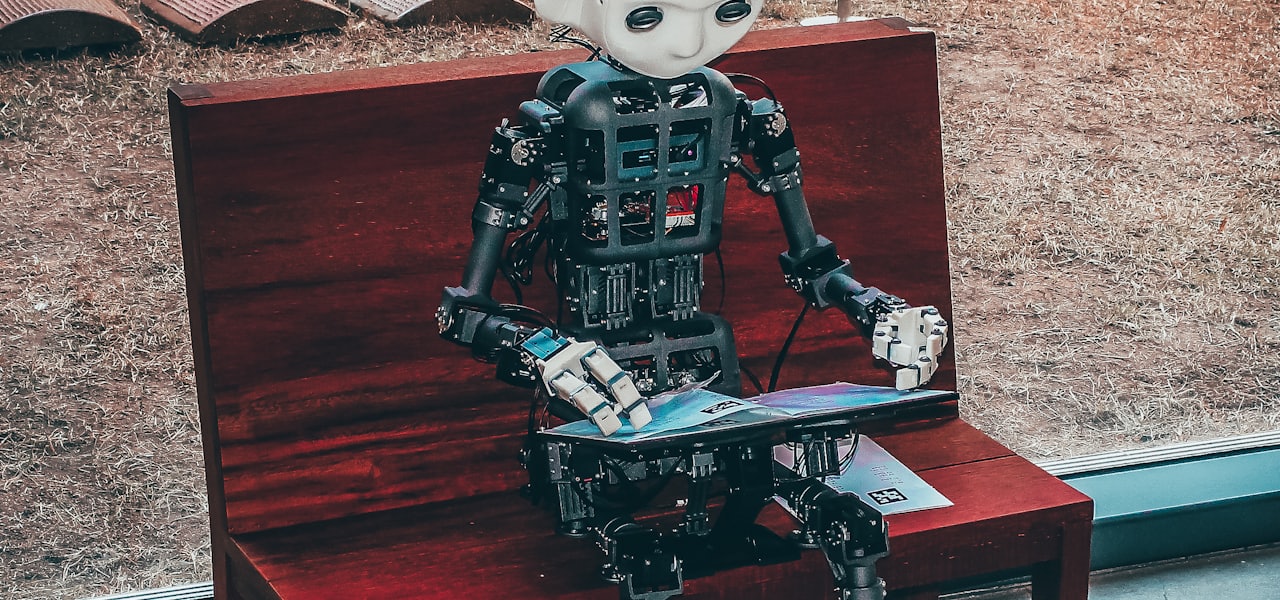
Neurorobotics is the combined study of neuroscience, robotics, and artificial intelligence. It is the science and technology of embodied autonomous neural systems. Neural systems include brain-inspired algorithms (e.g. connectionist networks), computational models of biological neural networks (e.g. artificial spiking neural networks, large-scale simulations of neural microcircuits) and actual biological systems (e.g. in vivo and in vitro neural nets). Such neural systems can be embodied in machines with mechanic or any other forms of physical actuation. This includes robots, prosthetic or wearable systems but also, at smaller scale, micro-machines and, at the larger scales, furniture and infrastructures. Neurorobotics is that branch of neuroscience with robotics, which deals with the study and application of science and technology of embodied autonomous neural systems like brain-inspired algorithms. It is based on the idea that the brain is embodied and the body is embedded in the environment. Therefore, most neurorobots are required to function in the real world, as opposed to a simulated environment. Beyond brain-inspired algorithms for robots neurorobotics may also involve the design of brain-controlled robot systems. == Major classes of models == Neurorobots can be divided into various major classes based on the robot's purpose. Each class is designed to implement a specific mechanism of interest for study. Common types of neurorobots are those used to study motor control, memory, action selection, and perception. === Locomotion and motor control === Neurorobots are often used to study motor feedback and control systems, and have proved their merit in developing controllers for robots. Locomotion is modeled by a number of neurologically inspired theories on the action of motor systems. Locomotion control has been mimicked using models or central pattern generators, clumps of neurons capable of driving repetitive behavior, to make four-legged walking robots. Other groups have expanded the idea of combining rudimentary control systems into a hierarchical set of simple autonomous systems. These systems can formulate complex movements from a combination of these rudimentary subsets. This theory of motor action is based on the organization of cortical columns, which progressively integrate from simple sensory input into a complex afferent signals, or from complex motor programs to simple controls for each muscle fiber in efferent signals, forming a similar hierarchical structure. Another method for motor control uses learned error correction and predictive controls to form a sort of simulated muscle memory. In this model, awkward, random, and error-prone movements are corrected for using error feedback to produce smooth and accurate movements over time. The controller learns to create the correct control signal by predicting the error. Using these ideas, robots have been designed which can learn to produce adaptive arm movements or to avoid obstacles in a course. === Learning and memory systems === Robots designed to test theories of animal memory systems. Many studies examine the memory system of rats, particularly the rat hippocampus, dealing with place cells, which fire for a specific location that has been learned. Systems modeled after the rat hippocampus are generally able to learn mental maps of the environment, including recognizing landmarks and associating behaviors with them, allowing them to predict the upcoming obstacles and landmarks. Another study has produced a robot based on the proposed learning paradigm of barn owls for orientation and localization based on primarily auditory, but also visual stimuli. The hypothesized method involves synaptic plasticity and neuromodulation, a mostly chemical effect in which reward neurotransmitters such as dopamine or serotonin affect the firing sensitivity of a neuron to be sharper. The robot used in the study adequately matched the behavior of barn owls. Furthermore, the close interaction between motor output and auditory feedback proved to be vital in the learning process, supporting active sensing theories that are involved in many of the learning models. Neurorobots in these studies are presented with simple mazes or patterns to learn. Some of the problems presented to the neurorobot include recognition of symbols, colors, or other patterns and execute simple actions based on the pattern. In the case of the barn owl simulation, the robot had to determine its location and direction to navigate in its environment. === Action selection and value systems === Action selection studies deal with negative or positive weighting to an action and its outcome. Neurorobots can and have been used to study simple ethical interactions, such as the classical thought experiment where there are more people than a life raft can hold, and someone must leave the boat to save the rest. However, more neurorobots used in the study of action selection contend with much simpler persuasions such as self-preservation or perpetuation of the population of robots in the study. These neurorobots are modeled after the neuromodulation of synapses to encourage circuits with positive results. In biological systems, neurotransmitters such as dopamine or acetylcholine positively reinforce neural signals that are beneficial. One study of such interaction involved the robot Darwin VII, which used visual, auditory, and a simulated taste input to "eat" conductive metal blocks. The arbitrarily chosen good blocks had a striped pattern on them while the bad blocks had a circular shape on them. The taste sense was simulated by conductivity of the blocks. The robot had positive and negative feedbacks to the taste based on its level of conductivity. The researchers observed the robot to see how it learned its action selection behaviors based on the inputs it had. Other studies have used herds of small robots which feed on batteries strewn about the room, and communicate its findings to other robots. === Sensory perception === Neurorobots have also been used to study sensory perception, particularly vision. These are primarily systems that result from embedding neural models of sensory pathways in automatas. This approach gives exposure to the sensory signals that occur during behavior and also enables a more realistic assessment of the degree of robustness of the neural model. It is well known that changes in the sensory signals produced by motor activity provide useful perceptual cues that are used extensively by organisms. For example, researchers have used the depth information that emerges during replication of human head and eye movements to establish robust representations of the visual scene. == Biological robots == Biological robots are not officially neurorobots in that they are not neurologically inspired AI systems, but actual neuron tissue wired to a robot. This employs the use of cultured neural networks to study brain development or neural interactions. These typically consist of a neural culture raised on a multielectrode array (MEA), which is capable of both recording the neural activity and stimulating the tissue. In some cases, the MEA is connected to a computer which presents a simulated environment to the brain tissue and translates brain activity into actions in the simulation, as well as providing sensory feedback The ability to record neural activity gives researchers a window into a brain, which they can use to learn about a number of the same issues neurorobots are used for. An area of concern with the biological robots is ethics. Many questions are raised about how to treat such experiments. The central question concerns consciousness and whether or not the rat brain experiences it. There are many theories about how to define consciousness. == Implications for neuroscience == Neuroscientists benefit from neurorobotics because it provides a blank slate to test various possible methods of brain function in a controlled and testable environment. While robots are more simplified versions of the systems they emulate, they are more specific, allowing more direct testing of the issue at hand. They also have the benefit of being accessible at all times, while it is more difficult to monitor large portions of a brain while the human or animal is active, especially individual neurons. The development of neuroscience has produced neural treatments. These include pharmaceuticals and neural rehabilitation. Progress is dependent on an intricate understanding of the brain and how exactly it functions. It is difficult to study the brain, especially in humans, due to the danger associated with cranial surgeries. Neurorobots can improved the range of tests and experiments that can be performed in the study of neural processes.
Tradeshift
Tradeshift is a cloud based business network and platform for purchase-to-pay automation, supply chain payments, marketplaces, virtual cards and supply chain financing. Its 2018 round of funding, led by Goldman Sachs, raised US$250 million at a valuation of $1.1 billion, giving the company unicorn status. Tradeshift is headquartered in San Francisco, California and has offices in London, Copenhagen, Bucharest and Kuala Lumpur. Tradeshift has reprocessed over $1 trillion USD through transactions on its network. == History == Tradeshift was founded in 2010 by Christian Lanng, Mikkel Hippe Brun, and Gert Sylvest. Inspiration for Tradeshift came after they created the world's first large scale peer-to-peer infrastructure for an e-business called NemHandel. The founders also had leading roles (Governing board member, Technical Director) in the European Commission project PEPPOL inside the European Union. In 2010, the Tradeshift platform launched in May in Copenhagen. Tradeshift won the European Startup Awards in the category of "Best Business or Enterprise Startup." In 2011, Tradeshift made its app marketplace available. In 2012, Tradeshift moved their headquarters from Copenhagen to San Francisco. In 2013, Tradeshift opened an R&D center in Suzhou, China. Tradeshift opened an additional office in London. And LATAM e-invoicing capabilities were added through partnership with Invoiceware. In 2014, Tradeshift expanded with offices in Tokyo, Paris, and Munich. The EU Commission officially approved the Universal Business Language (UBL) data format – a format Tradeshift supports – as eligible for referencing in tenders from public administrations. In 2015, Tradeshift won the Circulars "Digital Disruptor" Award at the WEF conference in Davos, Switzerland. Tradeshift also acquired product information management company Merchantry, and launched e-procurement and supplier risk management solutions. In 2016, Tradeshift acquired Hyper Travel and secured a $75 million series-D round funding. In 2017, Tradeshift acquired IBX Business Network and launches Tradeshift Ada. In 2018, Tradeshift secured a $250 million series-E round funding. and launched Blockchain Payments, the latter as part of Tradeshift Pay. In December 2018 Tradeshift acquired Babelway, an online B2B integration platform. The acquisition added three new office locations to Tradeshift (Salt Lake City, Louvain-la-neuve, Belgium, Cairo Egypt). In Q3 2018, Tradeshift reported year-over-year revenue growth of 400%, new bookings growth of 284%, and gross merchandise volume (GMV) growth of 262%. New total contract value also grew by US$47 million. Additionally, it added 27 new customers including Hertz, Shiseido, ECU and multiple Fortune 500 companies. In July 2023, HSBC and Tradeshift announced an agreement to launch a new, jointly owned business focused on the development of embedded finance solutions and financial services apps. As part of the agreement, HSBC made a $35 million investment into Tradeshift and joined its board. The agreement was part of a funding round which is expected to raise a minimum of $70 million from HSBC and other investors. The new joint venture will allow HSBC and Tradeshift to deploy a range of digital solutions across Tradeshift and other platforms. This includes payment and fintech services embedded into trade, e-commerce and marketplace experiences. In September 2023, CEO Lanng was fired for "gross misconduct on multiple grounds," including "allegations of sexual assault and harassment." Tradeshift was alleged to have fired his accuser after she complained to the company's human resources department, its co-founders and members of its board of directors about his abuse. == Financials == The company's valuation as of May 2018 was $1.1 billion. Tradeshift is now considered a unicorn, and, according to Bloomberg, will not need any further funding. Jan 14, 2020, Tradeshift announced that they had raised $240 million in Series F finance. == Acquisitions == In 2015, Tradeshift acquired product information management company Merchantry. Merchantry is a retail product information management (PIM) software for multi-vendor ecommerce retailers. In 2016, Tradeshift acquired Hyper Travel. Hyper Travel is a travel management service that allows customers to access travel agents via its native messaging apps, SMS, and email. In 2017, Tradeshift acquired IBX Group. In 2018, Tradeshift acquired Babelway, an online B2B integration platform.
Key-agreement protocol
In cryptography, a key-agreement protocol is a protocol whereby two (or more) parties generate a cryptographic key as a function of information provided by each honest party so that no party can predetermine the resulting value. In particular, all honest participants influence the outcome. A key-agreement protocol is a specialisation of a key-exchange protocol. At the completion of the protocol, all parties share the same key. A key-agreement protocol precludes undesired third parties from forcing a key choice on the agreeing parties. A secure key agreement can ensure confidentiality and data integrity in communications systems, ranging from simple messaging applications to complex banking transactions. Secure agreement is defined relative to a security model, for example the Universal Model. More generally, when evaluating protocols, it is important to state security goals and the security model. For example, it may be required for the session key to be authenticated. A protocol can be evaluated for success only in the context of its goals and attack model. An example of an adversarial model is the Dolev–Yao model. In many key exchange systems, one party generates the key, and sends that key to the other party; the other party has no influence on the key. == Exponential key exchange == The first publicly known public-key agreement protocol that meets the above criteria was the Diffie–Hellman key exchange, in which two parties jointly exponentiate a generator with random numbers, in such a way that an eavesdropper cannot feasibly determine what the resultant shared key is. Exponential key agreement in and of itself does not specify any prior agreement or subsequent authentication between the participants. It has thus been described as an anonymous key agreement protocol. == Symmetric key agreement == Symmetric key agreement (SKA) is a method of key agreement that uses solely symmetric cryptography and cryptographic hash functions as cryptographic primitives. It is related to symmetric authenticated key exchange. SKA may assume the use of initial shared secrets or a trusted third party with whom the agreeing parties share a secret is assumed. If no third party is present, then achieving SKA can be trivial: we tautologically assume that two parties that share an initial secret and have achieved SKA. SKA contrasts with key-agreement protocols that include techniques from asymmetric cryptography, such as key encapsulation mechanisms. The initial exchange of a shared key must be done in a manner that is private and integrity-assured. Historically, this was achieved by physical means, such as by using a trusted courier. An example of a SKA protocol is the Needham–Schroeder protocol. It establishes a session key between two parties on the same network, using a server as a trusted third party. The original Needham–Schroeder protocol is vulnerable to a replay attack. Timestamps and nonces are included to fix this attack. It forms the basis for the Kerberos protocol. === Types of key agreement === Boyd et al. classify two-party key agreement protocols according to two criteria as follows: whether a pre-shared key already exists or not the method of generating the session key. The pre-shared key may be shared between the two parties, or each party may share a key with a trusted third party. If there is no secure channel (as may be established via a pre-shared key), it is impossible to create an authenticated session key. The session key may be generated via: key transport, key agreement and hybrid. If there is no trusted third party, then the cases of key transport and hybrid session key generation are indistinguishable. SKA is concerned with protocols in which the session key is established using only symmetric primitives. == Authentication == Anonymous key exchange, like Diffie–Hellman, does not provide authentication of the parties, and is thus vulnerable to man-in-the-middle attacks. A wide variety of cryptographic authentication schemes and protocols have been developed to provide authenticated key agreement to prevent man-in-the-middle and related attacks. These methods generally mathematically bind the agreed key to other agreed-upon data, such as the following: public–private key pairs shared secret keys passwords === Public keys === A widely used mechanism for defeating such attacks is the use of digitally signed keys that must be integrity-assured: if Bob's key is signed by a trusted third party vouching for his identity, Alice can have considerable confidence that a signed key she receives is not an attempt to intercept by Eve. When Alice and Bob have a public-key infrastructure, they may digitally sign an agreed Diffie–Hellman key, or exchanged Diffie–Hellman public keys. Such signed keys, sometimes signed by a certificate authority, are one of the primary mechanisms used for secure web traffic (including HTTPS, SSL or TLS protocols). Other specific examples are MQV, YAK and the ISAKMP component of the IPsec protocol suite for securing Internet Protocol communications. However, these systems require care in endorsing the match between identity information and public keys by certificate authorities in order to work properly. === Hybrid systems === Hybrid systems use public-key cryptography to exchange secret keys, which are then used in a symmetric-key cryptography systems. Most practical applications of cryptography use a combination of cryptographic functions to implement an overall system that provides all of the four desirable features of secure communications (confidentiality, integrity, authentication, and non-repudiation). === Passwords === Password-authenticated key agreement protocols require the separate establishment of a password (which may be smaller than a key) in a manner that is both private and integrity-assured. These are designed to resist man-in-the-middle and other active attacks on the password and the established keys. For example, DH-EKE, SPEKE, and SRP are password-authenticated variations of Diffie–Hellman. === Other tricks === If one has an integrity-assured way to verify a shared key over a public channel, one may engage in a Diffie–Hellman key exchange to derive a short-term shared key, and then subsequently authenticate that the keys match. One way is to use a voice-authenticated read-out of the key, as in PGPfone. Voice authentication, however, presumes that it is infeasible for a man-in-the-middle to spoof one participant's voice to the other in real-time, which may be an undesirable assumption. Such protocols may be designed to work with even a small public value, such as a password. Variations on this theme have been proposed for Bluetooth pairing protocols. In an attempt to avoid using any additional out-of-band authentication factors, Davies and Price proposed the use of the interlock protocol of Ron Rivest and Adi Shamir, which has been subject to both attack and subsequent refinement.
Codebook
A codebook is a type of document used for gathering and storing cryptography codes. Originally, codebooks were often literally books, but today "codebook" is a byword for the complete record of a series of codes, regardless of physical format. == Cryptography == In cryptography, a codebook is a document used for implementing a code. A codebook contains a lookup table for coding and decoding; each word or phrase has one or more strings which replace it. To decipher messages written in code, corresponding copies of the codebook must be available at either end. The distribution and physical security of codebooks presents a special difficulty in the use of codes compared to the secret information used in ciphers, the key, which is typically much shorter. The United States National Security Agency documents sometimes use codebook to refer to block ciphers; compare their use of combiner-type algorithm to refer to stream ciphers. Codebooks come in two forms, one-part or two-part: In one-part codes, the plaintext words and phrases and the corresponding code words are in the same alphabetical order. They are organized similar to a standard dictionary. Such codes are half the size of two-part codes but are more vulnerable since an attacker who recovers some code word meanings can often infer the meaning of nearby code words. One-part codes may be used simply to shorten messages for transmission or have their security enhanced with superencryption methods, such as adding a secret number to numeric code words. In two-part codes, one part is for converting plaintext to ciphertext, the other for the opposite purpose. They are usually organized similarly to a language translation dictionary, with plaintext words (in the first part) and ciphertext words (in the second part) presented like dictionary headwords. The earliest known use of a codebook system was by Gabriele de Lavinde in 1379 working for the Antipope Clement VII. Two-part codebooks go back as least as far as Antoine Rossignol in the 1800s. From the 15th century until the middle of the 19th century, nomenclators (named after nomenclator) were the most used cryptographic method. Codebooks with superencryption were the most used cryptographic method of World War I. The JN-25 code used in World War II used a codebook of 30,000 code groups superencrypted with 30,000 random additives. The book used in a book cipher or the book used in a running key cipher can be any book shared by sender and receiver and is different from a cryptographic codebook. == Social sciences == In social sciences, a codebook is a document containing a list of the codes used in a set of data to refer to variables and their values, for example locations, occupations, or clinical diagnoses. == Data compression == Codebooks were also used in 19th- and 20th-century commercial codes for the non-cryptographic purpose of data compression. Codebooks are used in relation to precoding and beamforming in mobile networks such as 5G and LTE. The usage is standardized by 3GPP, for example in the document TS 38.331, NR; Radio Resource Control (RRC); Protocol specification.
Personal network
A personal network is a set of human contacts known to an individual, with whom that individual would expect to interact at intervals to support a given set of activities. In other words, a personal network is a group of caring, dedicated people who are committed to maintain a relationship with a person in order to support a given set of activities. Having a strong personal network requires being connected to a network of resources for mutual development and growth. Personal networks can be understood by: who knows you what you know about them what they know about you what are you learning together how you work at that Personal networks are intended to be mutually beneficial, extending the concept of teamwork beyond the immediate peer group. The term is usually encountered in the workplace, though it could apply equally to other pursuits outside work. Personal networking is the practice of developing and maintaining a personal network, which is usually undertaken over an extended period. The concept is related to business networking and is often encouraged by large organizations, in the hope of improving productivity, and so a number of tools exist to support the maintenance of networks. Many of these tools are IT-based, and use Web 2.0 technologies. == History of networking and business success == In the second half of the twentieth century, U.S. advocates for workplace equity popularized the term and concept of networking as part of a larger social capital lexicon—which also includes terms such as glass ceiling, role model, mentoring, and gatekeeper—serving to identify and address the problems barring non-dominant groups from professional success. Mainstream business literature subsequently adopted the terms and concepts, promoting them as pathways to success for all career climbers. In 1970 these terms were not in the general American vocabulary; by the mid-1990s they had become part of everyday speech. Before the mid-twentieth century, what we call networking today was framed in the language of family and friendship. These close personal relationships provided a range of opportunities to preferred subsets of people, such as access to job opportunities, information, credit, and partnerships. Family networks and nepotism have proven particularly strong throughout history. However, other common bonds—from ethnicity and religion to school ties and club memberships—can connect subsets of people as well. Of course people whom insiders consider undesirable have been barred from such networks, with important consequences. Those who tap into influential networks can be nurtured toward success. Those who are shut out from networks can lose hope of success. Numerous business heroes of the past—such as Benjamin Franklin, Andrew Carnegie, Henry Ford, and John D. Rockefeller—exploited networks to great effect. The business networks that seemed natural and transparent to these white men were a closed book to women and minorities for much of American history. Drawing on work from the social sciences, these outsider groups had to identify and then harness the mechanisms behind networking's power. A prominent early example of this process was the formation of corporate caucuses by black men at Xerox starting in 1969. Groups of black salesmen met regularly to share information about Xerox's culture and strategies for navigating it most effectively. Through confrontation and collaboration with a relatively accommodating upper management, the caucuses helped open opportunities for high-performing black employees. The popular and business press began using the terms "network" and "networking" in the mid-1970s in the context of businesswomen consciously pursuing this strategy. Authors encouraged female workers to recognize and exploit the informal workplace systems that provided advancement. They urged women to identify mentors, use social contacts, and build peer and authority networks. The push for networking drew on ideas and relationships from the era's feminist movement, and dictionaries of the time explicitly linked business networking to women's efforts to succeed in the workplace. Since the closing decades of the twentieth century, networking has become a pervasive term and concept in American society. People now invoke networking in relation to everything from business to child rearing to science. While ambitious careerists seek networks as an indispensable talisman, companies purposefully encourage networking among their employees to boost performance and gain competitive advantage. At the same time, Americans are forgetting the workplace activism that first illuminated the power of networking. Unfortunately, this loss of historical context can fuel a backlash against outsider groups who still seek to synthesize networks so they can access the same opportunities enjoyed by insiders. == Characteristics of networks == Broadly speaking, all networks have the following characteristics: Purpose – A network can be established for learning, mission, business, idea, and family or personal reasons. Structure – A network is a group of interlinked entities that form a cluster. Most social structures tend to be characterized by dense clusters of strong connections. Style – The place, space, pace and style of interaction of the networks give an understanding of the style of the networks. Namkee Park, Seungyoon Lee and Jang Hyun Kim examined the relations between personal network characteristics and Facebook use. According to their study, personal networks are investigated through several structural characteristics, which can be categorized into three major dimensions according to the level of analysis: Dyadic tie attributes which include the characteristics of ego-alter ties such as duration, multiplexity, and proximity. Ego-alter tie attributes represent various dimensions of relationships between the focal person and their close contacts. First, tie duration refers to the length of time since the tie was originally initiated, which indicates the duration of relationships. Second, multiplexity includes a focal individual's degree of involvement in various types of interactions with network members. The third dimension is the physical proximity between ego and alter. Theories of proximity suggest that physical proximity between people affects their interaction and subsequently, their formation of network ties. The characteristics of alter-alter ties including personal network density. When moving to ties at the alter-alter level, ego-network density, which refers to the extent to which one's alters are connected with each other, is an important dimension of personal networks. Dense personal network structure indicates close interpersonal contacts among alters, and consequently, is considered to promote the sharing of resources. On the other hand, loose connections, or structural holes in ego-networks, have been found to facilitate the flow of information and to provide advantages in searching and obtaining resources (e.g., getting a job). The composition of alter attributes centered on the heterogeneity of alters in one's personal network. The heterogeneity of alters in one's personal network is associated with access to diverse resources and information It is expected, thus, that the heterogeneity attributes may enhance the focal actor's social activities. Each of these characteristics represents unique aspects of individuals' network relationships. == Types of personal networks == Personal networks can be used for two main reasons: social and professional. In 2012, LinkedIn along with TNS conducted a survey of 6,000 social network users to understand the difference between personal social networks and personal professional networks. The "Mindset Divide" of users of these networks was compared as follows: Emotions: Personal social networks: Nostalgia, fun, distraction. Personal professional networks: Achievement, success, aspiration. Use: Personal social networks: Users are in a casual mindset often just passing time. They use social networks to socialize, stay in touch, be entertained and kill time. Personal professional networks: In this purposeful mindset, users invest time to improve themselves and their future. These networks are used to maintain professional identity, make useful contacts, search for opportunities and stay in touch. Content: Personal professional networks: These provide information about career, brand updates and current affairs. Professional development: Personal development networks: These provide access to those who can provide information, knowledge, advice, support, expertise, guidance, and concrete resources to learn and work effectively—thus those who support the continuing professional development. == Personal network management == Personal network management (PNM) is a crucial aspect of personal information management and can be understood as the practice of managing the links and connections for social and profession
Database dump
A database dump contains a record of the table structure and/or the data from a database and is usually in the form of a list of SQL statements ("SQL dump"). A database dump is most often used for backing up a database so that its contents can be restored in the event of data loss. Corrupted databases can often be recovered by analysis of the dump. Database dumps are often published by free content projects, to facilitate reuse, forking, offline use, and long-term digital preservation. Dumps can be transported into environments with Internet blackouts or otherwise restricted Internet access, as well as facilitate local searching of the database using sophisticated tools such as grep.
SFINKS
Sfinks (Polish for "Sphynx") was also the initial name of the Janusz A. Zajdel Award In cryptography, SFINKS is a stream cypher algorithm developed by An Braeken, Joseph Lano, Nele Mentens, Bart Preneel, and Ingrid Verbauwhede. It includes a message authentication code. It has been submitted to the eSTREAM Project of the eCRYPT network. In 2005, Nicolas T. Courtois noted that, while the cipher is elegant and secure against some simple algebraic attacks, it is vulnerable to more elaborate known attacks.